The 15 most in-demand federal campgrounds near Yosemite National Park
Upper Pines took about 201.8 reservations per site each year, the most of the 15 campgrounds we ranked. Half its campers booked ~2 months or more ahead, and its sites were an estimated 98% full in summer.
Updated Nov 3, 2026 · Data: Recreation.gov reservations FY2015–2025 · ranked by reservations per site
Find your part of Yosemite
Numbers match the ranking; tap a pin to jump to that campground. Campground locations: Recreation.gov. Park boundaries: National Park Service.
The top five
1Upper Pines CampgroundInside the park · near Yosemite Valley~2 months outtypical booking · 98% est. full201.8 res./site/yr · 113,531 total
2Hodgdon Meadow CampgroundInside the park · 15 mi from Yosemite Valley~6 weeks outtypical booking · 96% est. full169.7 res./site/yr · 41,686 total
3Wawona CampgroundInside the park · 13 mi from Yosemite Valley~2 months outtypical booking · 94% est. full160.7 res./site/yr · 36,801 total
4Sweetwater (Stanislaus National Forest)Stanislaus National Forest · 12 mi from Groveland~8 weeks outtypical booking · 93% est. full113.3 res./site/yr · 3,929 total
5Lower Pines CampgroundInside the park · near Yosemite Valley~3 months outtypical booking · 81% est. full109.8 res./site/yr · 18,808 total
Ranked by reservations per reservable site per year (FY2023–2025), so a small campground that fills up counts as much as a big one. "Typical booking" is when half of campers had already reserved; summer occupancy is our estimate (see how we measured).
01 · Yosemite Valley
Upper Pines Campground
The largest of the three reservation campgrounds in Yosemite Valley
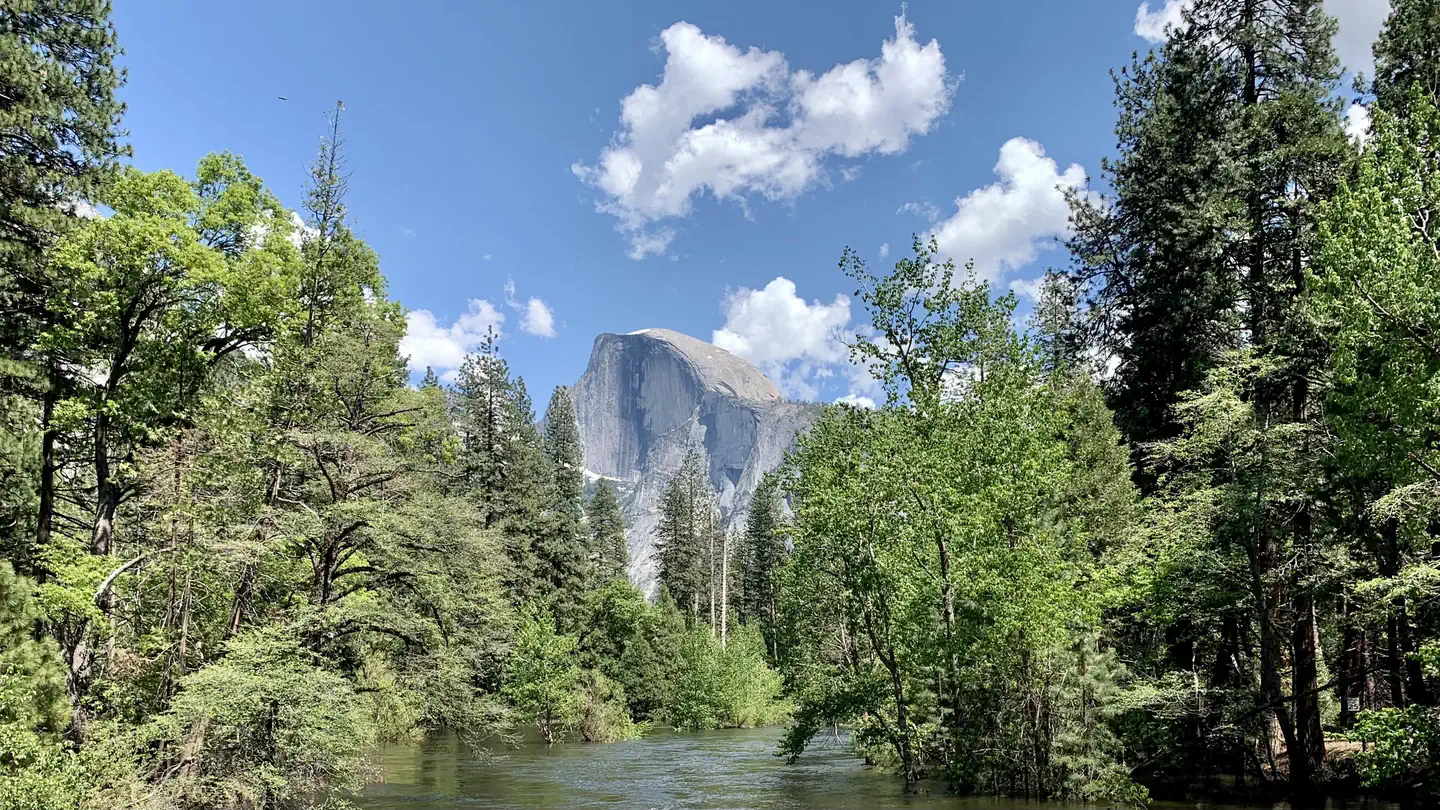
Half Dome in Spring from Sentinel Bridge.Photo: NPS-Eric Bissmeyer / Recreation.gov
Black oak, ponderosa pine and incense-cedar shade the sites, with the valley's granite cliffs visible through the trees and the Merced River nearby. The free valley shuttle stops at the entrance.
Half of May Friday and Saturday arrivals were reserved at least 124 days ahead, and a quarter at least 138 days ahead.
~2 months out typical booking~98% full in summer (est.)201.8 reservations per site / yrRanked 1st of 15 · 235 reservable sites · 113,531 reservations FY2023–2025
At 4,875 feet among red fir, incense-cedar, ponderosa and lodgepole pine, with wildflowers in the open meadows each summer.
~6 weeks out typical booking~96% full in summer (est.)169.7 reservations per site / yrRanked 2nd of 15 · 100 reservable sites · 41,686 reservations FY2023–2025
Pines and cedars along the South Fork of the Merced
Wawona campsite along the river.Photo: NPS-Susie Boatman / Recreation.gov
Near the park's southern end, forested with ponderosa pine, incense-cedar and white fir beside the gentle South Fork of the Merced River.
FY2024 was its busiest year on record, with 12,722 reservations; FY2025 was close behind at 12,307.
~2 months out typical booking~94% full in summer (est.)160.7 reservations per site / yrRanked 3rd of 15 · 97 reservable sites · 36,801 reservations FY2023–2025
Picnic Table and surrounding area.Photo: Forest Service / Recreation.gov
Stanislaus National Forest · 12 mi from Groveland
~8 weeks out typical booking~93% full in summer (est.)113.3 reservations per site / yrRanked 4th of 15 · 13 reservable sites · 3,929 reservations FY2023–2025
Yosemite National Park.Photo: Eric Bissmeyer, NPS / Recreation.gov
Inside the park · near Yosemite Valley
Half of September Friday and Saturday arrivals were reserved at least 104 days ahead, and a quarter at least 137 days ahead.
~3 months out typical booking~81% full in summer (est.)109.8 reservations per site / yrRanked 5th of 15 · 74 reservable sites · 18,808 reservations FY2023–2025
All 15 campgrounds, ranked by reservations per site
Typical booking: median days between booking and arrival, FY2023–2025. Peak season, est. full: reserved site-nights ÷ (reservable sites × nights) in summer (June–August), 2023–2025; blank where we couldn't estimate it reliably. Ranking is reservations per reservable site per year, averaged over the FY2023–2025 years each campground took reservations (campgrounds that joined Recreation.gov recently are marked "Partial history"). Details in About this data.
Not ranked, because Recreation.gov doesn't list a reliable count of individual reservable sites (group, cabin or shared sites, fewer than 10 sites, or site records that don't match the bookings): Camp 4 (3,743 reservations), White Wolf Campground (3,103 reservations), Dry Gulch (463 reservations), Recreation Point (378 reservations).
Recorded reservations rose from about 118,000 a year before 2020 to nearly 187,000 in FY2025.
117,643 a year on average in FY2015–2019, 186,377 in FY2025, across all 32 campgrounds we studied. FY2020–21 were shaped by COVID closures and the camping surge.
FY15
FY16
FY17
FY18
FY19
98,071FY20COVID
110,417FY21COVID
FY22
FY23
FY24
186,377FY25
The set of campgrounds on Recreation.gov changed over these years (some, like Sweetwater (Stanislaus National Forest) and Gull Lake, joined recently), so part of the change reflects which campgrounds were bookable there, not only how many people camped.
All values
FY2015: 108,163
FY2016: 114,770
FY2017: 113,867
FY2018: 128,695
FY2019: 122,722
FY2020: 98,071 (COVID year)
FY2021: 110,417 (COVID year)
FY2022: 158,212
FY2023: 152,631
FY2024: 174,882
FY2025: 186,377
Find a Yosemite campsite for your dates
Compare current openings and prices around Yosemite National Park.
Data: Recreation.gov reservations FY2015–2025. These are Recreation.gov's public reservation records (the RIDB historical reservation files), covering every federal campground in the area that took at least 300 reservations in FY2023–2025. Federal fiscal years run October to September, so FY2025 is October 2024 through September 2025.
Which campgrounds are included. Every federal campground inside Yosemite National Park or within 30 miles of its center point (straight-line distance) that takes reservations on Recreation.gov. Area / setting comes from each campground's Recreation.gov coordinates and managing agency; nearby towns are straight-line.
How we ranked. By reservations per reservable site per year: a campground's FY2023–2025 reservations divided by its number of reservable sites, averaged over the years in that span when it took reservations (at least one full fiscal year), so a campground that joined Recreation.gov recently isn't undercounted. This lets a small campground that books up compare fairly with a big one. Reservable sites are the individual overnight sites Recreation.gov lists for the campground; group sites, cabins, lookouts, yurts, shelters, boat-in and day-use sites are left out, and so are their reservations. Campgrounds with fewer than 10 such sites, or whose site records don't match the bookings (for example shared walk-in sites), aren't ranked and are listed under the table.
Typical booking time. The median number of days between the day a reservation was made and the arrival date, across all FY2023–2025 reservations at that campground: half of campers booked at least that far ahead. Profiles turn the busiest month's weekend figure into calendar dates for the next season, worked out from today's date.
Estimated summer occupancy. The share of possible site-nights in summer (June–August) of 2023, 2024 and 2025 that had a reservation: reserved site-nights ÷ (reservable sites × nights in the season). It's an estimate. Cancellations aren't in the data, so it can run high; sites closed for repairs or late openings make it run low. Each site-night counts once. We leave it blank where the site count is unreliable or the result came out over 100%.
No "% available". These records show what was booked, not what was open on a given day, so we don't estimate availability from them. The "Sites open" tags come from our live availability check and only appear when it confirms open sites.
Bookings, not occupancy. Each count is a reservation made. Cancellations aren't in the data, so a booked site may later have opened up, and nights a campground was closed simply show no bookings.
COVID years are flagged. FY2020 and FY2021 were shaped by closures, capacity limits and a camping surge, so we mark them and don't use them for "then vs now" comparisons.
Lead time is the days between the booking date and the arrival date. Weekend means a Friday or Saturday arrival. First-come, pay-on-arrival sites are left out of lead times.
Only campgrounds that take reservations on Recreation.gov are included. State parks, private campgrounds and first-come campgrounds aren't in these numbers.